JEFFREY SCHIFF

  • bio
  • contact

High Mesa

Rose Art Museum, Brandeis University  1986
fir, stone, concrete
18′ x 23′ x 23′

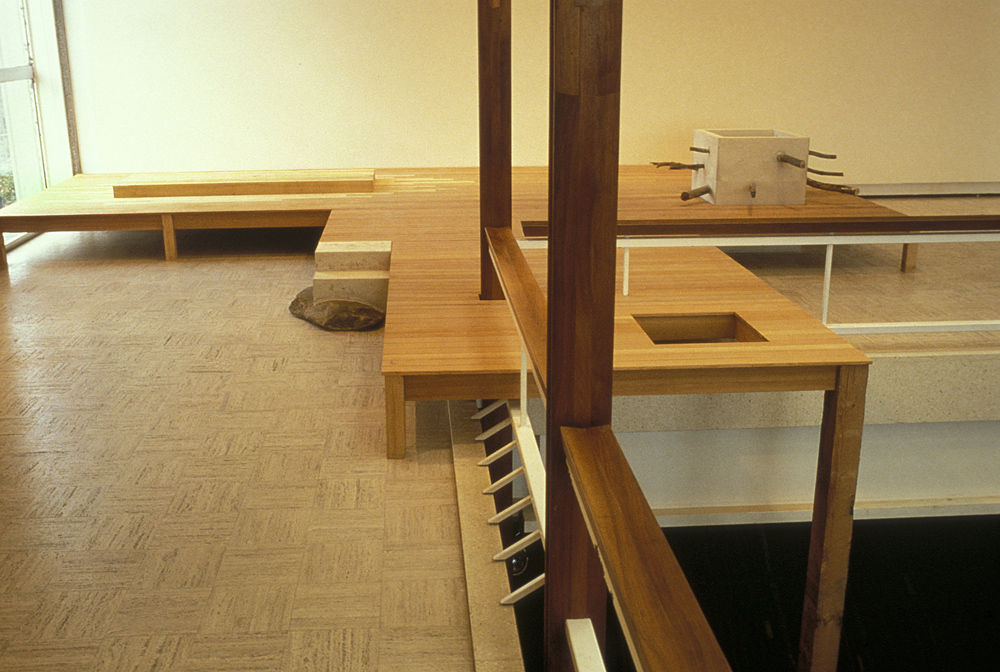
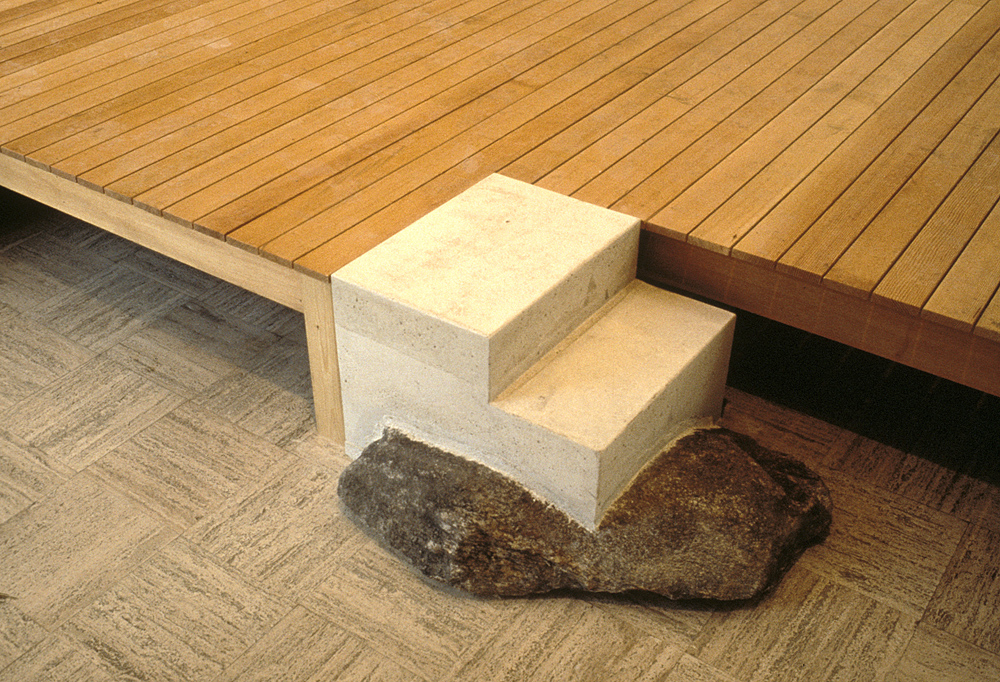
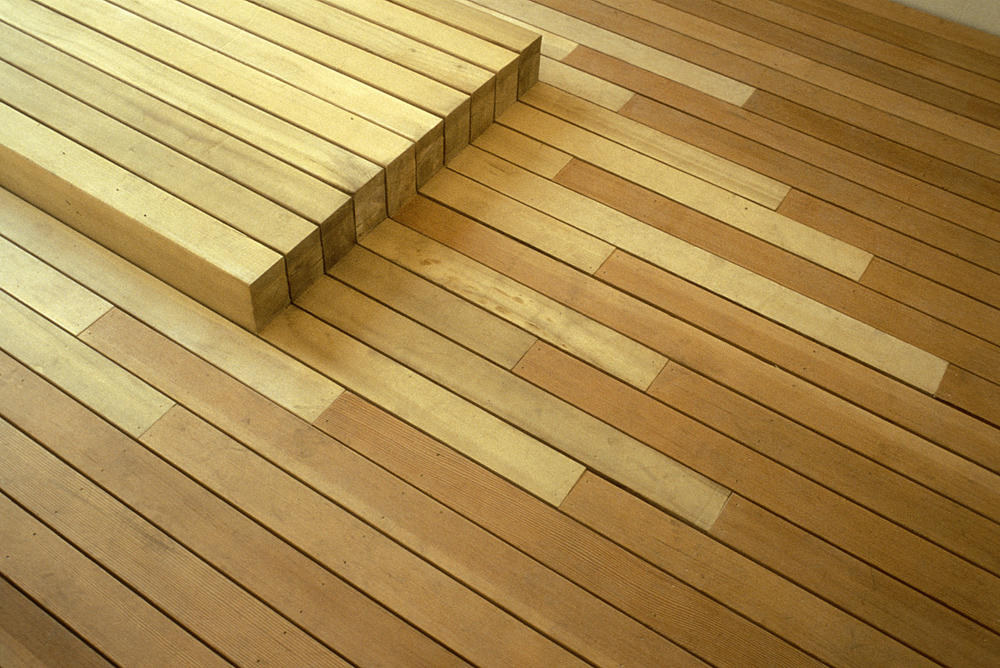
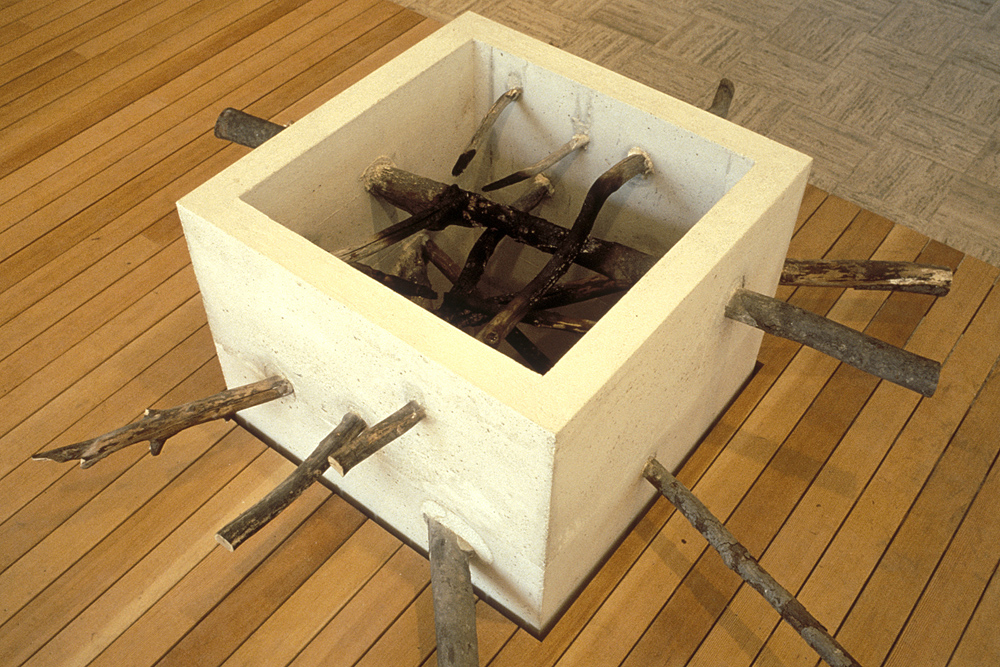
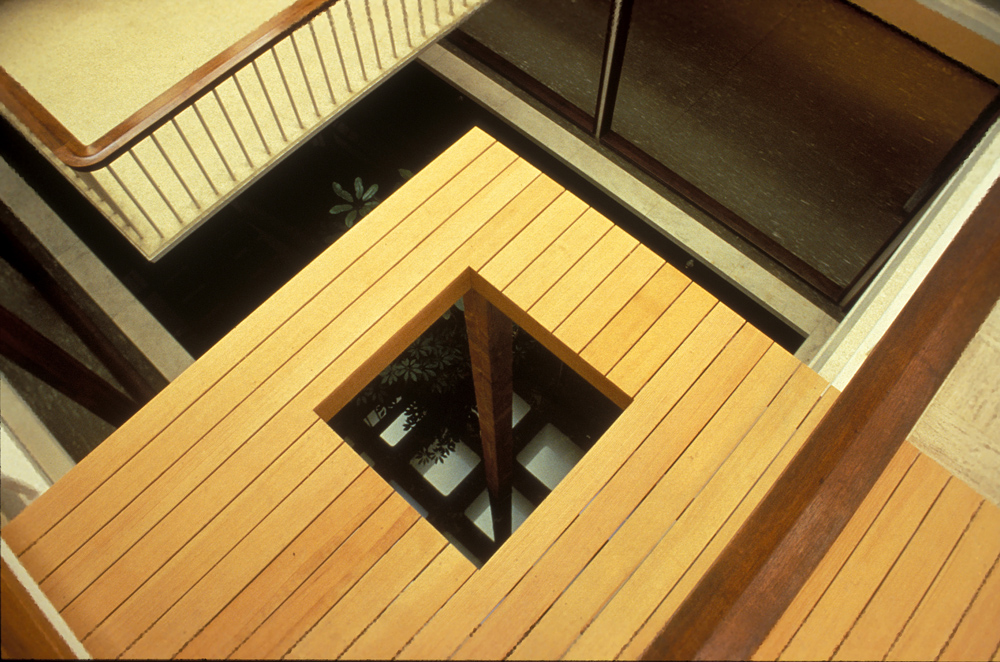
A platform constructed within the gallery architecture, High Mesa is an archetypal artist’s dwelling. A small boulder and cast stair steps up from the gallery’s travertine floor to an elevated wooden platform that embraces and penetrates the gallery architecture. A thickened and bleached wooden area marks a place of repose before a window onto the landscape. A cast plaster well penetrated by burnt tree branches forms a hearth; and an opening cut into the floor overhanging the gallery stairwell and a pool of water below marks a vertiginous well.

essays and reviews

ROSE ART MUSEUM
Brandeis University

High Mesa: a plateau atop a Cliffside, looking out over a landscape vista and down onto a spring below. As envisioned by sculptor Jeffrey Schiff, these are nature’s counterparts to the architectural elements of the museum’s topography, specifically floor, staircase, window and pool. Built into this visionary landscape he has conceived and constructed a dwell: a minimal archetypal living space with floor, bed, hearth and well. So begins our journey though Schiff’s sculptural environment where sensations are unlocked and visions inspired – quietly and slowly over time.

In the coexistent realities that are revealed and the rich overlays that emerge between nature and architecture (museum, mesa and dwelling), natural and man-made materials (branches, stone, lumber, concrete), and the interplay between pre-existing and newly created spaces forms, we discover multiple references to the complex layers of meaning and experience common to any environment we encounter during the normal course of our daily lives.

Likening the dwelling to an artist’s studio, Schiff sees this sculpture as a holistic environment dedicated to the creative process itself. He has constructed three distinct but integrated physical spaces, each designating a particular type of function or behavior. Our passage from one space to another is across an elevated wood floor, accessible via three steps made of natural stone and concrete. There we encounter these forms: a bed – a restful contemplative place belonging to the interior but visually connected to the outside; a hearth (whose charred branches are evidence of atleast a singe use) – a place where a creative process is enacted and physically realized; a well – an extension of a safe interior space to a possibly dangerous exterior one.

With High Mesa, Schiff puts us in touch with our own physical presence in known and unknown spaces and explores the complex but delicate interplay of form, space, perception and experience.

THE BOSTON HERALD, Sunday, March 23, 1986

New Works by N.E. Sculptors
Rose Museum exhibits run from the highly finished to the playful
By, Nancy Stapen

“Sculptural objects and Installations: The Lois Foster Exhibition of Boston and New England Area Artists” – the 10th annual exhibition at the Rose Art Museum at Brandeis University – is presenting new work by local artists.

Previous shows have concentrated on new talent, but this year, museum Director Carl Belz has created an elegant and unusual show of six sculptors with established reputations.

Works by most of these artists are rarely seen in Boston. The size, scope and ambition of such artists as Jeffrey Schiff, Jim Coates and Eric Lintala make museum and gallery exposure difficult.

Even for orthodox artists, sculpture is difficult to market. It’s expensive, often unwieldy and occupies a lot of space. That intimidates many collectors.

In this high-caliber show, the Rose offers a range of work – from highly finished to playful and transitional.

For some contemporary sculptors, the reference point remains minimalism – the austere, repetitive style that held sway in the 1960s though early 1970s. But in the late 1970s, sculpture went in many directions. The styles included object-oriented, figurative, architectural, found object and installation. All may be characterized as post-minimalist directions.

Jeffrey Schiff’s evocative installation “High Mesa” is a sophisticated, complex work. Lodged in the left corner of the top-floor gallery, it convinces on formal, architectural and psychological levels. It combines sensitivity to the airy, horseshoe-shaped upper gallery, which overlooks an interior pool and fountain, with knowledge of the woodlands surrounding the Rose.

Sprawling horizontally in the back corner, a raised platform of blond wood (Douglas fir) is divided by suggested furniture into three areas. A bleached wood “bed” is laid below the floor-to-ceiling corner window. On a sunny afternoon, the bed is flooded with light, inviting the outer world of nature into this interior space of architectural shelter. Behind it, a 48-inch concrete square pierced by charred branches suggests a hearth or kitchen.

In a brilliant manipulation of space, Schiff has cantilevered a corner of the platform over the balcony, which itself becomes an integral element o the piece. From a precipitous vantage, the viewer may gaze down though a 2-foot cut-out square, an image suggesting an exterior well.

More straightforward is Jim Coates’ “The Rose-Lean-to Installation,” in which a set of three large triangular wood-and-rope structures evoke primitive dwellings.

Eric Lintala’s “Perimetric Containment,” which turns a downstairs gallery into an imaginary, desertlike environment, is enclosed yet expansive. Lintala has divided the room into triangular vistas of sand that hug the wall, supported by waist-high wooden constructions. The beige brown painted wood and warm color of the sand softened by atmospheric lighting result in an earth, meditative ambience. Lintala’s manipulations of perspective produce an illusion of swelling and contraction.

The three object-oriented sculptors explore distinct concerns. Howard Ben Tre’s cast glass-and-copper columns have a majestic presence. Based on simple, industrial forms, these have the clearest relationship to minimalism. Still, their evocatively textured surfaces, fanciful capitals and variant bases provide a wealth of visual detail.

George Creamer’s whimsical, pastel-painted branches juxtapose a polished, highly finished surfaces with the quality of a nervous gesture. These works achieve a lank humor when placed directly on the floor. They become sensuously elegant when placed on pedestals.

Lastly, Mags Harries is Boston’s best-known public sculptor, both for her Haymarket installation and more recently Porter Square “Glove Cycle.” She shows wall reliefs that playfully take apart the objects they depict. Plastic replicas of fruit, mugs and travelogue trays are split open and titled upward in a collaged cubist pun. (Through April 13)
 
Related Posts
Inscription 2
Inscriptions
READ MORE
Manworldfellthrough
Bellagio Rockefeller Drawings
2002 each drawing: 18"x23.25" graphite on paper Rubbings made from the Rockefeller Foundation seal on the grounds of the Bellagio Study Center.
READ MORE
from L’Encyclopédie: Miroitier Photoworks
Collection City of New York  1997 Epson digital prints on paper, each 20"x15" Each object from the inventory in the Encyclopedia engravings is isolated as a solitary vignette by layering a nearly ...
READ MORE
Chidambaram: Yajnayudhani
1998 paper and acrylic paint 77-1/2"x72" (48  12"x9" drawings) A set of 48 painted images of Vedic ritual objects.
READ MORE
Excavations (detail)
The Library Project: Excavations
2003 2 cases, each 40"x72"x28" Excavations uses the typical glass display cases used to exhibit books in libraries everywhere. These cases usually open a book to exhibit one selected spread, leaving the ...
READ MORE
Istanbul Wall 
(39"x62")
reConstructions
2013-14 digital epson prints on paperPhotographs pinned one over another to rebuild the depicted walls.
READ MORE
The Library Project: Cover to Cover
digital print mounted on sintra, 12 panels each 25" x 15" Cover to Cover explores the juxtapositions and meanings one constructs from the information, ideas, and images in the library. The piece ...
READ MORE
Shattered
Shattered
2011-12 terra cotta, hydrocal Shattered terra cotta urns from Terra Cotta Incognito mounted on hydrocal slabs.
READ MORE
O Sole Mio
O Sole Mio
Boston Center for the Arts  1990 wood, sheetrock, steel, rubber, casters, tape player 10' x 13' x 7' In a group exhibition in which Kennedy/Violich Architects had been commissioned to design individual spaces ...
READ MORE
The Library Project: Yeast
ink on paper 10' x 12' Yeast is a diagram that examines the computerized keyword access system that has replaced the card catalog. This is a large chart that traces the pathways ...
READ MORE
Inscriptions
Bellagio Rockefeller Drawings
from L’Encyclopédie: Miroitier Photoworks
Chidambaram: Yajnayudhani
The Library Project: Excavations
reConstructions
The Library Project: Cover to Cover
Shattered
O Sole Mio
The Library Project: Yeast

  • Installations
    • Double Vision: Transactions of the American Philosophical SocietyDouble Vision: Transactions of the American Philosophical Society
    • The Library ProjectThe Library Project
    • from L’Encyclopédie: Miriotierfrom L’Encyclopédie: Miriotier
    • Mobile GlobalMobile Global
    • Vertical HoldVertical Hold
    • Potter’s FieldPotter’s Field
    • Everywhere ChidambaramEverywhere Chidambaram
    • Everyday ChidambaramEveryday Chidambaram
    • Sole ContactSole Contact
    • Earth AgainEarth Again
    • Deux Ex MachinaDeux Ex Machina
    • If Ever…If Ever…
    • Kill Van KullKill Van Kull
  • Public Commissions
    • DestinationsDestinations
    • Rail of JusticeRail of Justice
  • Sculpture
    • Carpet RubbleCarpet Rubble
    • ContingenciesContingencies
    • DisThermiaDisThermia
    • Lean-Tos and Floor-PilesLean-Tos and Floor-Piles
    • SchemataSchemata
    • EmbedsEmbeds
    • Casting BlocksCasting Blocks
    • KneelersKneelers
    • DevicesDevices
    • TransparenciesTransparencies
  • Performance
    • Praying ProjectPraying Project
    • ColossusColossus
    • Second MesaSecond Mesa
  • Interactivity
    • Sole ContactSole Contact
    • Potter’s FieldPotter’s Field
    • KneelersKneelers
    • Everywhere ChidambaramEverywhere Chidambaram
  • Photo Work
    • InterruptionsInterruptions
    • Contingencies: PhotoworksContingencies: Photoworks
    • reConstructionsreConstructions
    • from L’Encyclopédie: Miriotier Photoworksfrom L’Encyclopédie: Miriotier Photoworks
  • Drawings
    • Ink MapsInk Maps
    • Rome/Bologna DrawingsRome/Bologna Drawings
    • Bellagio Rockefeller DrawingsBellagio Rockefeller Drawings
    • The Library Project: YeastThe Library Project: Yeast
    • NetworksNetworks
    • Color MapsColor Maps
  • Archive
    • Odds and Ends
    • I.C.A. ProjectI.C.A. Project
    • W.P.A. ProjectW.P.A. Project
    • RevisionRevision
    • Second SightSecond Sight
    • A Courtyard, an Axis, an AmbulatoryA Courtyard, an Axis, an Ambulatory
    • High MesaHigh Mesa
    • New GroundNew Ground
    • Separate GroundSeparate Ground
    • O Sole MioO Sole Mio
    • If Ever…If Ever…
    • Second MesaSecond Mesa
    • PossessionsPossessions

High Mesa

August 28, 2014 by jschiff@wesleyan.edu

Rose Art Museum, Brandeis University  1986
fir, stone, concrete
18′ x 23′ x 23′

A platform constructed within the gallery architecture, High Mesa is an archetypal artist’s dwelling. A small boulder and cast stair steps up from the gallery’s travertine floor to an elevated wooden platform that embraces and penetrates the gallery architecture. A thickened and bleached wooden area marks a place of repose before a window onto the landscape. A cast plaster well penetrated by burnt tree branches forms a hearth; and an opening cut into the floor overhanging the gallery stairwell and a pool of water below marks a vertiginous well.

essays and reviews

ROSE ART MUSEUM
Brandeis University

High Mesa: a plateau atop a Cliffside, looking out over a landscape vista and down onto a spring below. As envisioned by sculptor Jeffrey Schiff, these are nature’s counterparts to the architectural elements of the museum’s topography, specifically floor, staircase, window and pool. Built into this visionary landscape he has conceived and constructed a dwell: a minimal archetypal living space with floor, bed, hearth and well. So begins our journey though Schiff’s sculptural environment where sensations are unlocked and visions inspired – quietly and slowly over time.

In the coexistent realities that are revealed and the rich overlays that emerge between nature and architecture (museum, mesa and dwelling), natural and man-made materials (branches, stone, lumber, concrete), and the interplay between pre-existing and newly created spaces forms, we discover multiple references to the complex layers of meaning and experience common to any environment we encounter during the normal course of our daily lives.

Likening the dwelling to an artist’s studio, Schiff sees this sculpture as a holistic environment dedicated to the creative process itself. He has constructed three distinct but integrated physical spaces, each designating a particular type of function or behavior. Our passage from one space to another is across an elevated wood floor, accessible via three steps made of natural stone and concrete. There we encounter these forms: a bed – a restful contemplative place belonging to the interior but visually connected to the outside; a hearth (whose charred branches are evidence of atleast a singe use) – a place where a creative process is enacted and physically realized; a well – an extension of a safe interior space to a possibly dangerous exterior one.

With High Mesa, Schiff puts us in touch with our own physical presence in known and unknown spaces and explores the complex but delicate interplay of form, space, perception and experience.

THE BOSTON HERALD, Sunday, March 23, 1986

New Works by N.E. Sculptors
Rose Museum exhibits run from the highly finished to the playful
By, Nancy Stapen

“Sculptural objects and Installations: The Lois Foster Exhibition of Boston and New England Area Artists” – the 10th annual exhibition at the Rose Art Museum at Brandeis University – is presenting new work by local artists.

Previous shows have concentrated on new talent, but this year, museum Director Carl Belz has created an elegant and unusual show of six sculptors with established reputations.

Works by most of these artists are rarely seen in Boston. The size, scope and ambition of such artists as Jeffrey Schiff, Jim Coates and Eric Lintala make museum and gallery exposure difficult.

Even for orthodox artists, sculpture is difficult to market. It’s expensive, often unwieldy and occupies a lot of space. That intimidates many collectors.

In this high-caliber show, the Rose offers a range of work – from highly finished to playful and transitional.

For some contemporary sculptors, the reference point remains minimalism – the austere, repetitive style that held sway in the 1960s though early 1970s. But in the late 1970s, sculpture went in many directions. The styles included object-oriented, figurative, architectural, found object and installation. All may be characterized as post-minimalist directions.

Jeffrey Schiff’s evocative installation “High Mesa” is a sophisticated, complex work. Lodged in the left corner of the top-floor gallery, it convinces on formal, architectural and psychological levels. It combines sensitivity to the airy, horseshoe-shaped upper gallery, which overlooks an interior pool and fountain, with knowledge of the woodlands surrounding the Rose.

Sprawling horizontally in the back corner, a raised platform of blond wood (Douglas fir) is divided by suggested furniture into three areas. A bleached wood “bed” is laid below the floor-to-ceiling corner window. On a sunny afternoon, the bed is flooded with light, inviting the outer world of nature into this interior space of architectural shelter. Behind it, a 48-inch concrete square pierced by charred branches suggests a hearth or kitchen.

In a brilliant manipulation of space, Schiff has cantilevered a corner of the platform over the balcony, which itself becomes an integral element o the piece. From a precipitous vantage, the viewer may gaze down though a 2-foot cut-out square, an image suggesting an exterior well.

More straightforward is Jim Coates’ “The Rose-Lean-to Installation,” in which a set of three large triangular wood-and-rope structures evoke primitive dwellings.

Eric Lintala’s “Perimetric Containment,” which turns a downstairs gallery into an imaginary, desertlike environment, is enclosed yet expansive. Lintala has divided the room into triangular vistas of sand that hug the wall, supported by waist-high wooden constructions. The beige brown painted wood and warm color of the sand softened by atmospheric lighting result in an earth, meditative ambience. Lintala’s manipulations of perspective produce an illusion of swelling and contraction.

The three object-oriented sculptors explore distinct concerns. Howard Ben Tre’s cast glass-and-copper columns have a majestic presence. Based on simple, industrial forms, these have the clearest relationship to minimalism. Still, their evocatively textured surfaces, fanciful capitals and variant bases provide a wealth of visual detail.

George Creamer’s whimsical, pastel-painted branches juxtapose a polished, highly finished surfaces with the quality of a nervous gesture. These works achieve a lank humor when placed directly on the floor. They become sensuously elegant when placed on pedestals.

Lastly, Mags Harries is Boston’s best-known public sculptor, both for her Haymarket installation and more recently Porter Square “Glove Cycle.” She shows wall reliefs that playfully take apart the objects they depict. Plastic replicas of fruit, mugs and travelogue trays are split open and titled upward in a collaged cubist pun. (Through April 13)


You May Also Like

Inscriptions
Embeds
Casting Blocks

Copyright © 2026 · Genesis Framework · WordPress · Log in