JEFFREY SCHIFF

  • bio
  • contact

A Courtyard, an Axis, an Ambulatory

Stux Gallery, Boston MA  1982
cast plaster

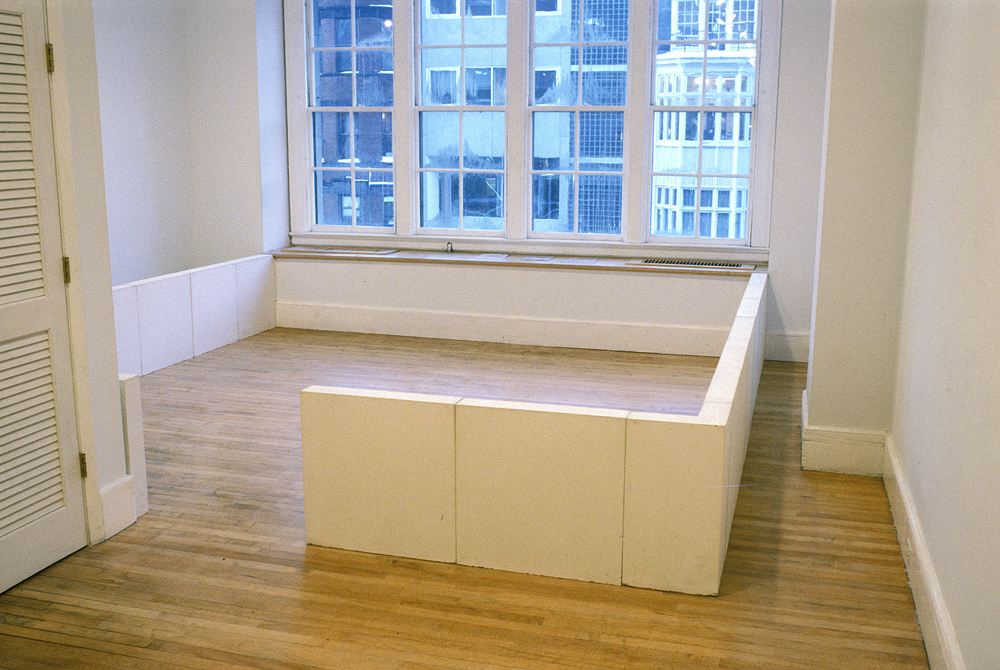
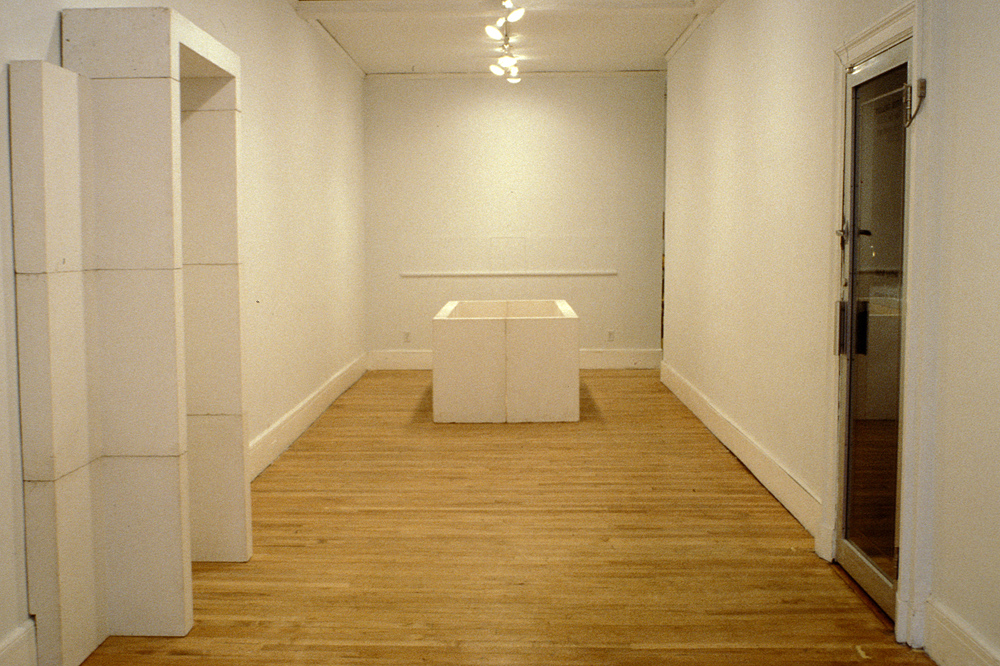
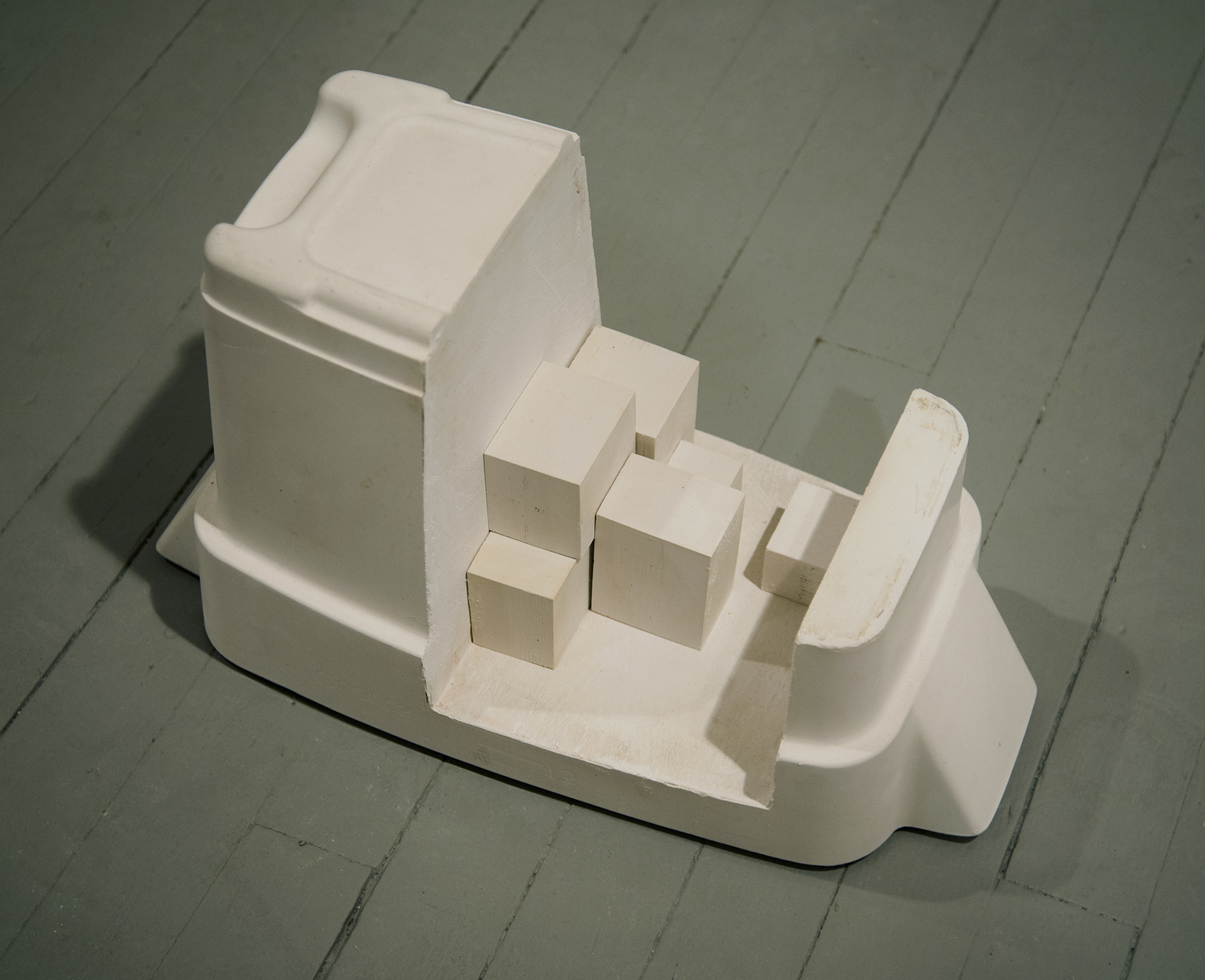
Based on Heidegger’s famous analogy of the bridge, the barely suggested characteristics of courtyard, axis, and ambulatory already present in the gallery are completed with the insertion of large cast plaster blocks that form doorway (to receive the axis from the gallery entrance), low wall (to complete the implied courtyard), and sarcophagus-like center structure (to force ambulation around the form).

essays and reviews

A Courtyard, an Axis, An Ambulatory

THE BOSTON PHOENIX, January 28, 1982
By Kenneth Baker

The key to Jeffrey Schiff’s installation at the Stux Gallery, on the Newbury Street (though January 30), is a quotation from Heidegger that sits alongside the artist’s biography on the window ledge. The quotation is one of the most famous passages from his late writings; in it he asserts that the banks of a river come into being as banks only in the presence of a bridge connecting them.

Schiff apparently intends his installation to be the bridge to the gallery structure’s banks. The show has three components; they’re assembled with cast plaster blocks, and Schiff calls them “A Courtyard,” “An Axis,” and “An Ambulatory.” As physical units, the modularity and individual identity. There is a pleasing dissimilarity between the most regular of them and those that are notched to fit closely under the window ledge or against the baseboards.

The three structures that form the installation are about as similar and as different as their elementary components, at least formally. But the “Axis,” which mirrors the gallery entrance, is a weak link in the show. The two floor pieces are much more effective in their restatement of the spatial dimensions of the gallery.

In looking at work like Schiff’s, it is worth remembering that the physical structure are not ends in themselves but devices intended to focus our attention on certain varieties of experience that might otherwise elude us Ð varieties of experience that might not even exist. The partial closure of the windowed end of the gallery with low plaster slabs (“A Courtyard”), for instance, enables us to feel the openness of that space in a way that is simply not possible when the gallery is as open as it can be. Similarly, the “Courtyard” makes us aware of the daylight entering the windows as a force that gives the space its character; it achieves this by forming an open container into which we can sense daylight falling. These observations naturally make us more aware of the gallery’s artificial light: we see its artificiality more clearly. Parallel observations could be made about the effects of the “Ambulatory” on the other end of the gallery, which is narrower and windowless.

Schiff’s work presupposes our interest in subtleties of experience and physical awareness. It is not oriented toward consumption but toward reflection, and for this reason many will likely dismiss it as “conceptual” or simply empty. But one reason people resort to such dismissals, apart from impatience and the habit of consumption, is to avoid the kinds of experience that works of art can provide us about ourselves, to avoid seeing and thinking beyond the crude categories we ordinarily use to orient ourselves. It is difficult to judge work like Schiff’s in terms of success or failure Ð too much depends on our willingness to exert the critical energy the artist requires. You will probably like or dislike the work less for its physical and visual character than for its affinity with your idea of what should be done with art by those who look at it.
 
Related Posts
Everyday Chidambaram
1998-2002 black granite, household objects (soap, plastic kitchenware, sponge, etc. Variable Dimensions In Everyday Chidambaram, granite plinths, based on details of Indian temple architecture, were customized to house the disposable objects of daily rituals—plastic ...
READ MORE
Double Vision: Text photographs
Double Vision: Text Photographs
digital photographs mounted on sintra approx. 50"x 40" each Enlarged photographic prints of three narratives from the published Transactions of the American Philosophical Society: Two Hearts found in one Partridge; Account of ...
READ MORE
O Sole Mio
O Sole Mio
Boston Center for the Arts  1990 wood, sheetrock, steel, rubber, casters, tape player 10' x 13' x 7' In a group exhibition in which Kennedy/Violich Architects had been commissioned to design individual spaces ...
READ MORE
Casting Blocks
Casting Blocks
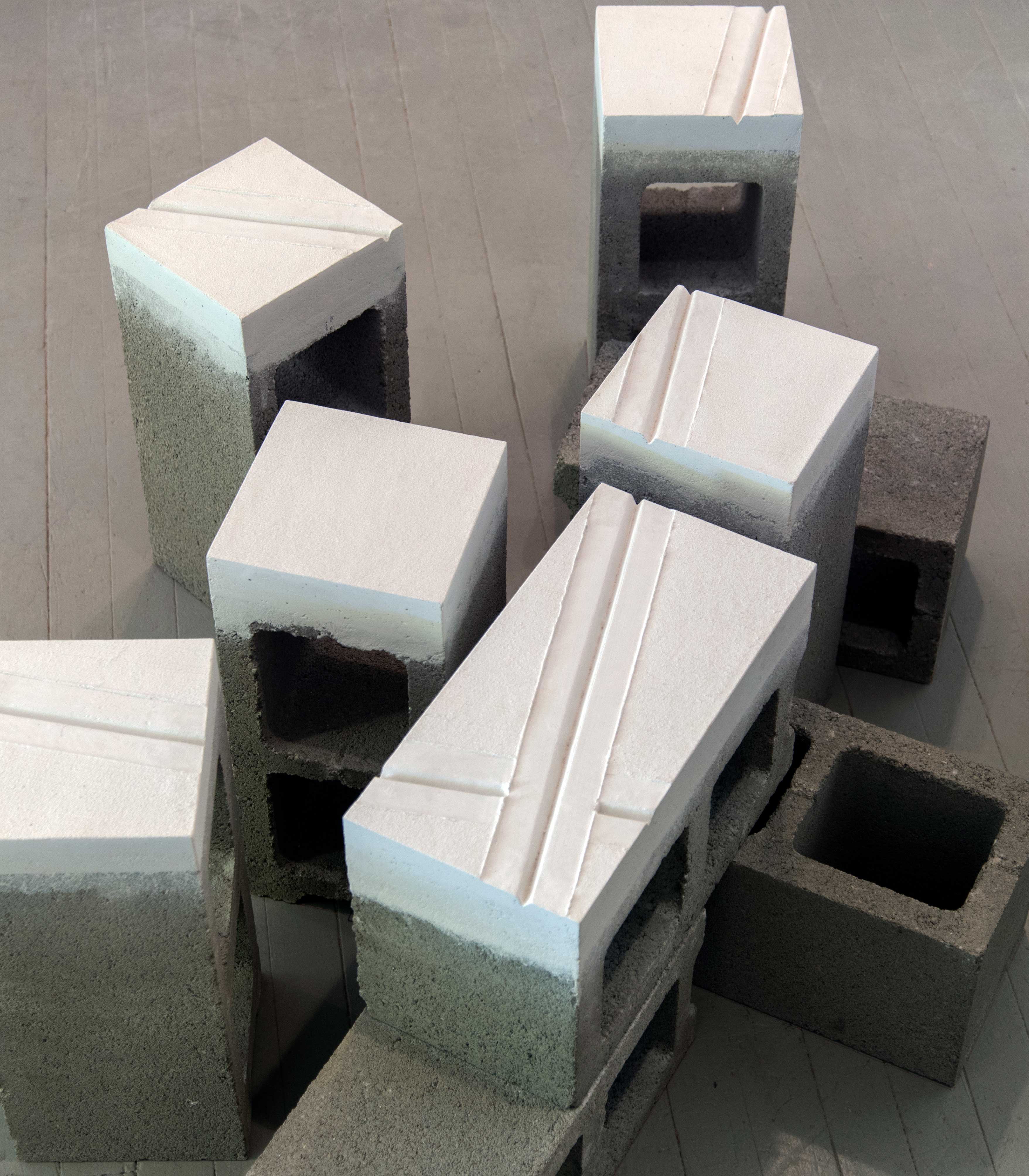
2014 cast hydrocal
READ MORE
Lean-To 1
Lean-Tos and Floor-Piles
2007-10 found wood, steel Found wooden boards are stacked and leaned in provisional order, forming a casual or unintended set of interrelations. A steel counter-structure holds the elements in their exact places, ...
READ MORE
Separate Ground
Separate Ground
Collection University of Massachusetts, Amherst  1983 granite boulder, concrete, fir 2.5' x 30' x 5' A square cast concrete well intersects an enormous stone boulder, framing a section of the boulder. This transitional ...
READ MORE
Excavations (detail)
The Library Project: Excavations
2003 2 cases, each 40"x72"x28" Excavations uses the typical glass display cases used to exhibit books in libraries everywhere. These cases usually open a book to exhibit one selected spread, leaving the ...
READ MORE
W.P.A. Project
W.P.A. Project
1980 graphite on walls, floors, ceiling 14' x 31' x 39' Graphite powder was rubbed into the walls, ceiling, and carpeted floor to define a rectangular space in contrast to the trapezoidal shape ...
READ MORE
Istanbul Wall 
(39"x62")
reConstructions
2013-14 digital epson prints on paperPhotographs pinned one over another to rebuild the depicted walls.
READ MORE
Networks
Networks
1992-3 oilstick on paper notecards variable The Network drawings are mappings of an intuitive passage from one self-created place to another, the formation of relationships out of nothing. They are intentionally structural and ...
READ MORE
Everyday Chidambaram
Double Vision: Text Photographs
O Sole Mio
Casting Blocks
Lean-Tos and Floor-Piles
Separate Ground
The Library Project: Excavations
W.P.A. Project
reConstructions
Networks

  • Installations
    • Double Vision: Transactions of the American Philosophical SocietyDouble Vision: Transactions of the American Philosophical Society
    • The Library ProjectThe Library Project
    • from L’Encyclopédie: Miriotierfrom L’Encyclopédie: Miriotier
    • Mobile GlobalMobile Global
    • Vertical HoldVertical Hold
    • Potter’s FieldPotter’s Field
    • Everywhere ChidambaramEverywhere Chidambaram
    • Everyday ChidambaramEveryday Chidambaram
    • Sole ContactSole Contact
    • Earth AgainEarth Again
    • Deux Ex MachinaDeux Ex Machina
    • If Ever…If Ever…
    • Kill Van KullKill Van Kull
  • Public Commissions
    • DestinationsDestinations
    • Rail of JusticeRail of Justice
  • Sculpture
    • Carpet RubbleCarpet Rubble
    • ContingenciesContingencies
    • DisThermiaDisThermia
    • Lean-Tos and Floor-PilesLean-Tos and Floor-Piles
    • SchemataSchemata
    • EmbedsEmbeds
    • Casting BlocksCasting Blocks
    • KneelersKneelers
    • DevicesDevices
    • TransparenciesTransparencies
  • Performance
    • Praying ProjectPraying Project
    • ColossusColossus
    • Second MesaSecond Mesa
  • Interactivity
    • Sole ContactSole Contact
    • Potter’s FieldPotter’s Field
    • KneelersKneelers
    • Everywhere ChidambaramEverywhere Chidambaram
  • Photo Work
    • InterruptionsInterruptions
    • Contingencies: PhotoworksContingencies: Photoworks
    • reConstructionsreConstructions
    • from L’Encyclopédie: Miriotier Photoworksfrom L’Encyclopédie: Miriotier Photoworks
  • Drawings
    • Ink MapsInk Maps
    • Rome/Bologna DrawingsRome/Bologna Drawings
    • Bellagio Rockefeller DrawingsBellagio Rockefeller Drawings
    • The Library Project: YeastThe Library Project: Yeast
    • NetworksNetworks
    • Color MapsColor Maps
  • Archive
    • Odds and Ends
    • I.C.A. ProjectI.C.A. Project
    • W.P.A. ProjectW.P.A. Project
    • RevisionRevision
    • Second SightSecond Sight
    • A Courtyard, an Axis, an AmbulatoryA Courtyard, an Axis, an Ambulatory
    • High MesaHigh Mesa
    • New GroundNew Ground
    • Separate GroundSeparate Ground
    • O Sole MioO Sole Mio
    • If Ever…If Ever…
    • Second MesaSecond Mesa
    • PossessionsPossessions

A Courtyard, an Axis, an Ambulatory

August 28, 2014 by jschiff@wesleyan.edu

Stux Gallery, Boston MA  1982
cast plaster

Based on Heidegger’s famous analogy of the bridge, the barely suggested characteristics of courtyard, axis, and ambulatory already present in the gallery are completed with the insertion of large cast plaster blocks that form doorway (to receive the axis from the gallery entrance), low wall (to complete the implied courtyard), and sarcophagus-like center structure (to force ambulation around the form).

essays and reviews

A Courtyard, an Axis, An Ambulatory

THE BOSTON PHOENIX, January 28, 1982
By Kenneth Baker

The key to Jeffrey Schiff’s installation at the Stux Gallery, on the Newbury Street (though January 30), is a quotation from Heidegger that sits alongside the artist’s biography on the window ledge. The quotation is one of the most famous passages from his late writings; in it he asserts that the banks of a river come into being as banks only in the presence of a bridge connecting them.

Schiff apparently intends his installation to be the bridge to the gallery structure’s banks. The show has three components; they’re assembled with cast plaster blocks, and Schiff calls them “A Courtyard,” “An Axis,” and “An Ambulatory.” As physical units, the modularity and individual identity. There is a pleasing dissimilarity between the most regular of them and those that are notched to fit closely under the window ledge or against the baseboards.

The three structures that form the installation are about as similar and as different as their elementary components, at least formally. But the “Axis,” which mirrors the gallery entrance, is a weak link in the show. The two floor pieces are much more effective in their restatement of the spatial dimensions of the gallery.

In looking at work like Schiff’s, it is worth remembering that the physical structure are not ends in themselves but devices intended to focus our attention on certain varieties of experience that might otherwise elude us Ð varieties of experience that might not even exist. The partial closure of the windowed end of the gallery with low plaster slabs (“A Courtyard”), for instance, enables us to feel the openness of that space in a way that is simply not possible when the gallery is as open as it can be. Similarly, the “Courtyard” makes us aware of the daylight entering the windows as a force that gives the space its character; it achieves this by forming an open container into which we can sense daylight falling. These observations naturally make us more aware of the gallery’s artificial light: we see its artificiality more clearly. Parallel observations could be made about the effects of the “Ambulatory” on the other end of the gallery, which is narrower and windowless.

Schiff’s work presupposes our interest in subtleties of experience and physical awareness. It is not oriented toward consumption but toward reflection, and for this reason many will likely dismiss it as “conceptual” or simply empty. But one reason people resort to such dismissals, apart from impatience and the habit of consumption, is to avoid the kinds of experience that works of art can provide us about ourselves, to avoid seeing and thinking beyond the crude categories we ordinarily use to orient ourselves. It is difficult to judge work like Schiff’s in terms of success or failure Ð too much depends on our willingness to exert the critical energy the artist requires. You will probably like or dislike the work less for its physical and visual character than for its affinity with your idea of what should be done with art by those who look at it.


You May Also Like

Inscriptions
Embeds
Casting Blocks

Copyright © 2026 · Genesis Framework · WordPress · Log in