JEFFREY SCHIFF

  • bio
  • contact

I.C.A. Project

Institute Of Contemporary Art, Boston, MA  1979
graphite powder on architectural surfaces
12′ x 28′ x 28′

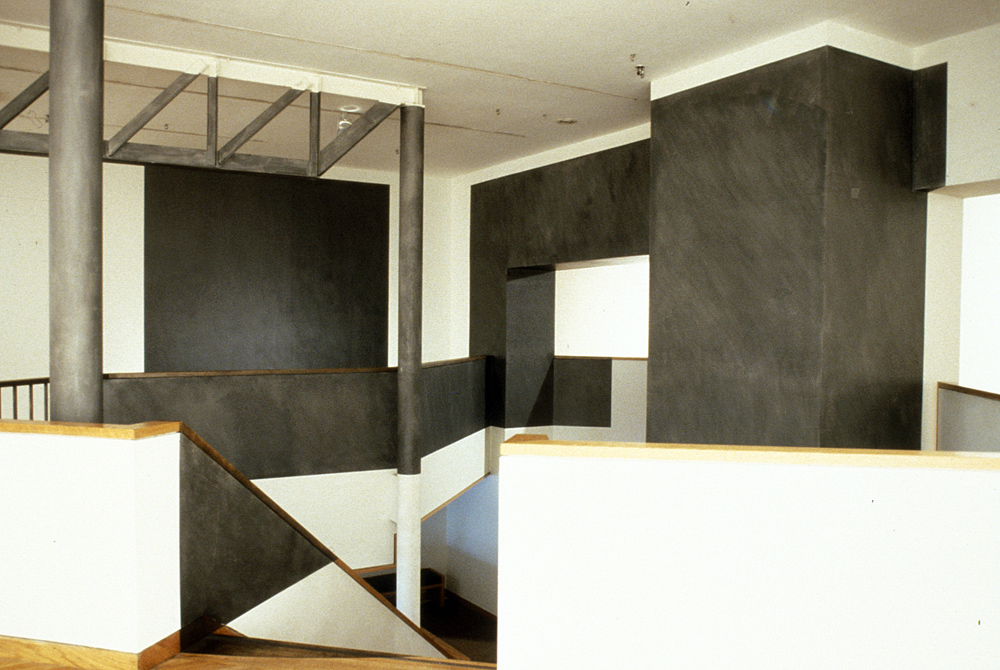
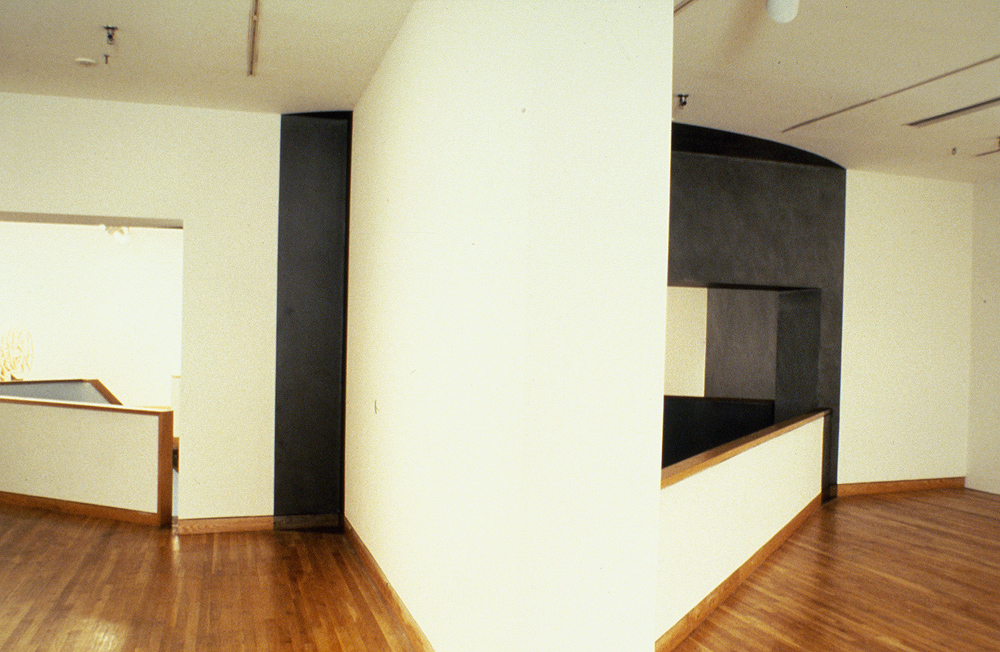
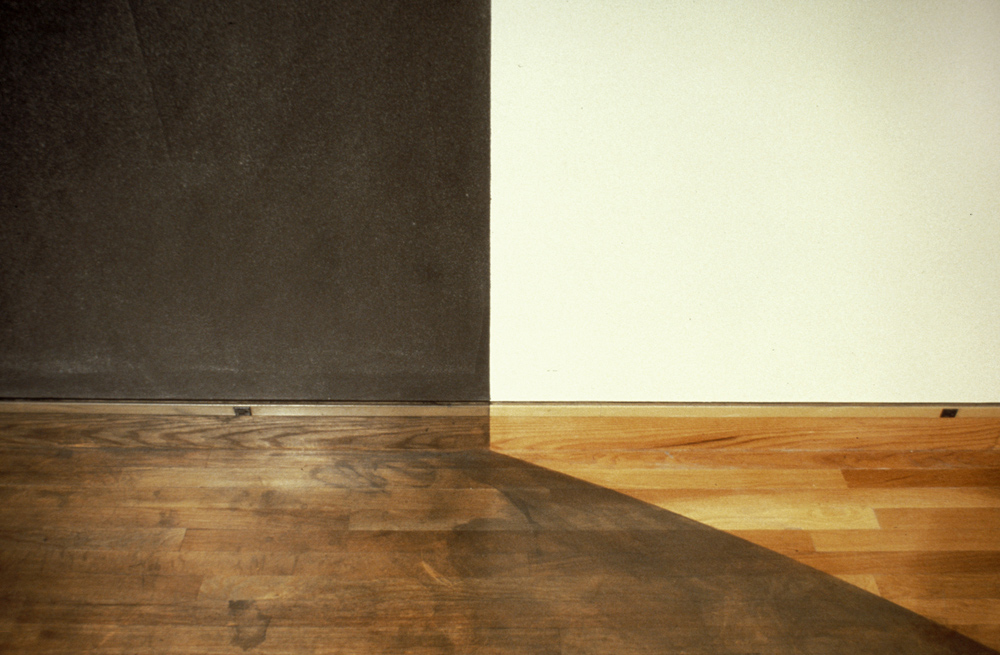
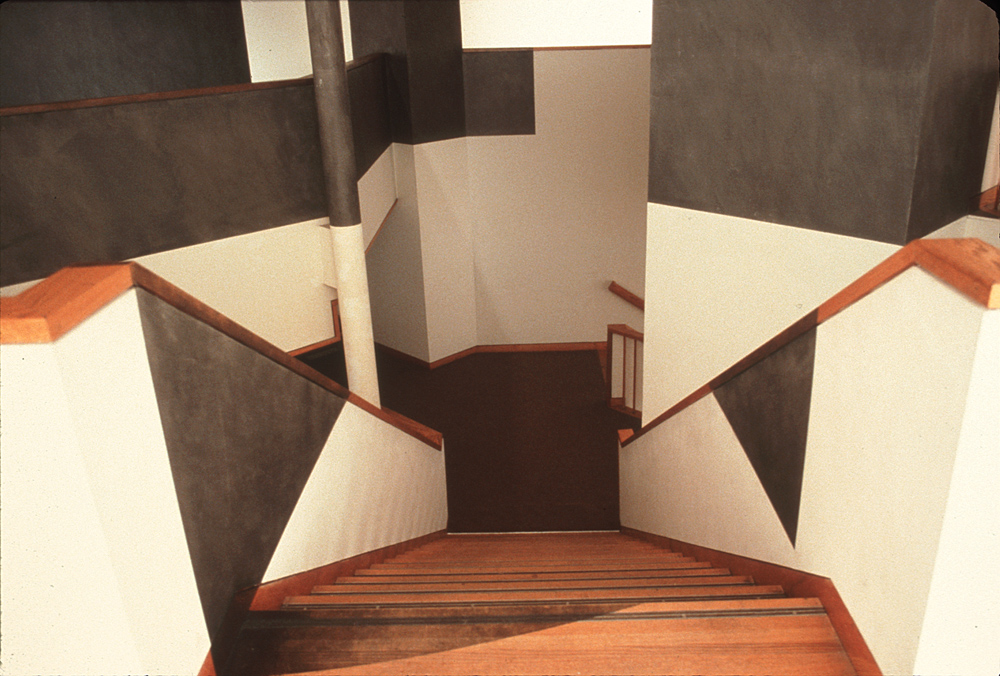
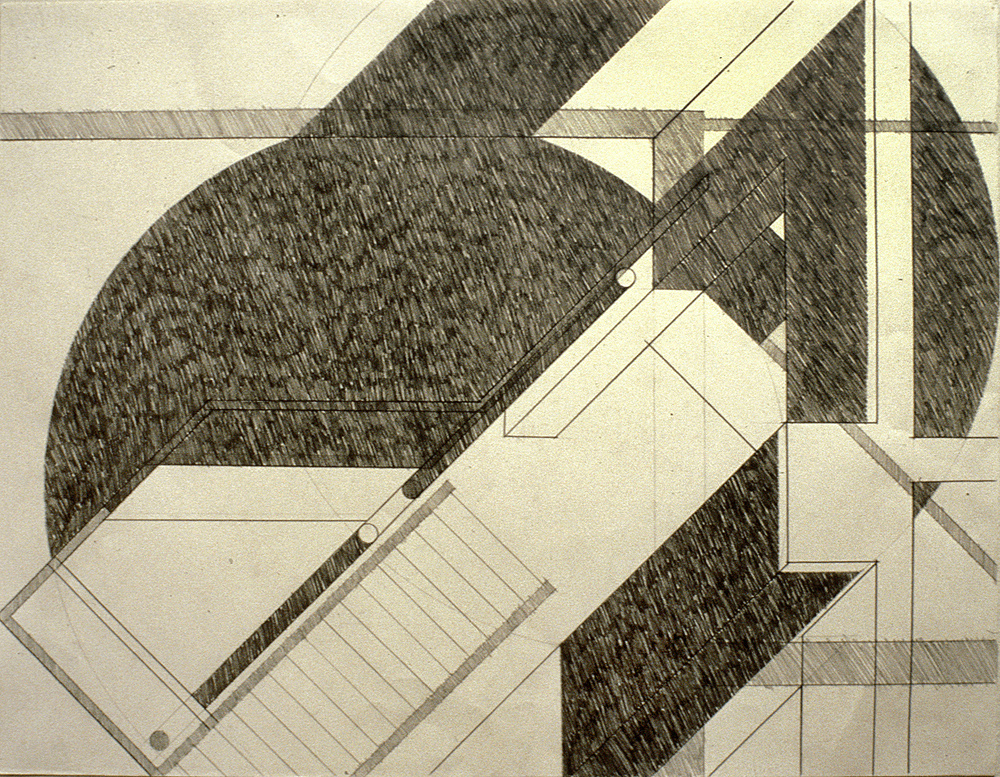
This installation imposed a drawing of an imaginary space into the architectural space in which it is situated. Solely through the application of graphite powder onto the existing floors, walls, and columns of the rooms, a fictive space became palpable, oppositional to the architecture and yet entirely dependant on it. The imaginary space was generated by using the existing columns as centerpoint and radius to describe a cylindrical space within the gallery space. The purity of the fictive space was fractured into numerous fragments when applied to the existing architectural forms.

essays and reviews

ARTFORUM – October, 1979
Boston
“Six Sculptors.” Institute of Contemporary Art:
by Ronald J. Onorato

The most visually exciting piece in the exhibition was that of JEFFREY SCHIFF. Like Rothfarb, Schiff created his own space but with more ephemeral means – he made no objects, he build no structures. In one sense, the space Schiff used was given as he chose to rework part of the remodeled interior of the institute’s 19th-century building. His chosen area, the main staircase leading to the second floor where the rest of the exhibition was held, is not a very well defined space. It is really a large, open, multisided well cutting between floors. Several turns, a landing, open and closed banisters and the fact that all second floor galleries open onto the well make the space confusing the incoherent. Schiff brings to this awkward architecture a rational clarity – in an unexpected way, by hand-rubbing graphite in a predetermined pattern around the case. Schiff demarcates a cylinder centered on an extant structural column. As a simple, strong vertical rising though the amorphous well, the column provides the pinion on which the rest of Schiff’s conception revolves. All the architecture that falls within his cylindrical boundary – walls, floors, overhead exposed steel beams, banisters, etc. – is covered with the dark powder.

At no single point do Schiff’s shadowed walls resolve completely, but they frame voids, reveal connections between spaces and even pick out various nuances of proportion and detail usually hidden by the homogeneity of white gallery walls. Schiff plays with the space. He wrests it out of its doldrums and gives it back to his audience as his own. With the most evanescent means, Schiff provides an experience spatially startling and visually sensitive.


DRAWING – November – December 1983
Excerpt from: A Dictionary of Assumptions: Drawings by Contemporary Sculptors
By Ronald J. Onorato

One young artist working out of Boston represents a younger subgeneration of those who would directly engage architecture and the environment. Jeff Schiff has often relied on drawing as the most available, most accessible means of developing his large-scale projects. In the late 1970s, he drew several proposals involving the planting of trees in specific patterns, sometimes couples with a structure of his own design. In Porch House Project for a Dense Forest, 1977-80, Schiff projected the pattern of trees and the layout of a covered, rectangular, cloisterlike structure in the relatively wide graduation of tones available to him though a detailed graphite drawing. Sometimes, his plans would include graphic overlays of orthogonal projections or splayed walls (not unlike an unfolded paper box), this to present all the pertinent information that he experience in extant architecture (as in San Bernardino, 1980) or that he wanted his audience to experience in his own creations (as in Shift, 1979).

Drawing was never as central to any sculptor’s activity, however, as it has been in a series of works produced by Schiff between a series of works produced by Schiff between 1979 and 1981. In these projects, Schiff’s sculptural act is a graphic act as he manipulates his audience’s perception of an existing space by coating certain areas of the architecture with dark, metallic grey graphite powder. He might envision an atriumlike court offset within a gallery space (as he did at the University of Rhode Island in 1980) or a complex, cylinder clarification of a complex stairwell (as at the Institute of Contemporary Art, Boston, 1979). In effect, he gets us to see his spaces, re-ëditions, or even corrections of given sites though the act of rubbing graphite onto walls, ceilings, rugs, thermostats, banisters, and any other architectural elements within his chosen workspace. We experience his sculptural space by literally inhabiting one of his drawings.

Unlike others who transcribe, sometimes with great clarity, their sculptural idea onto a two-dimensional surface, Schiff has managed to incorporate an ancient activity into his manipulation of space as he hand-colors a wall, a section of floor, an edge of a door, or a load-bearing beam.

Schiff’s work underscores the role that drawing splay for all these artists. The flay page offers them a second mode of visual expression. They find in it the means to organize and image their initial ideas and record their accomplishments. It also allows them the freedom to hone and assert what might otherwise be ignored in the structures they build and the spaces they define.

I.C.A. Project


Related Posts
If Ever…
If Ever…
...if ever the silver cord be loosed, or the golden bowl be broken..." Zilkha Gallery, Wesleyan University  1989 steel, lead, lead wire, limestone 24' x 21' x 19' A steel rack supporting 19 steel ...
READ MORE
Destinations II
Destinations II
South Station Railroad Terminal, Boston, MA  1995-2014 In 2014 Destinations was reconfigured to make way for an escalator installed in the center of the Dewey Square entry hall. All of the original ...
READ MORE
Excavations (detail)
The Library Project: Excavations
2003 2 cases, each 40"x72"x28" Excavations uses the typical glass display cases used to exhibit books in libraries everywhere. These cases usually open a book to exhibit one selected spread, leaving the ...
READ MORE
Second Mesa
Second Mesa
Set for Douglas Dunn and Dancers Institute of Contemporary Art, Boston  1983 A collaboration with choreographer Douglas Dunn and composer John Driscoll, this commission from the I.C.A. encompassed the entire two floors ...
READ MORE
W.P.A. Project
W.P.A. Project
1980 graphite on walls, floors, ceiling 14' x 31' x 39' Graphite powder was rubbed into the walls, ceiling, and carpeted floor to define a rectangular space in contrast to the trapezoidal shape ...
READ MORE
Double Vision: Propositions
flame-worked glass, steel, rubber, oil, water, lab tableChemistry lab-ware separating oil from water mounted on lab tables.
READ MORE
Chidambaram: Yajnayudhani
1998 paper and acrylic paint 77-1/2"x72" (48  12"x9" drawings) A set of 48 painted images of Vedic ritual objects.
READ MORE
Rome/Bologna Drawings
Ink on paper 2009
READ MORE
Schemata 2
Schemata
2009 terra cotta, hemp, plaster Terracotta plates, bowls and pots dropped on the floor and smashed, their fragments linked by line in their new locations and proximities.
READ MORE
collaboration with Aki Sasamoto
Praying Project
Collaboration with Aki Sasamoto Exit Art, NYC  2005 Block of soap with puja offerings, water, brass bowl, speech A performative extension of Everything Chidambaram, a large block of soap cast with puja offering ...
READ MORE
If Ever…
Destinations II
The Library Project: Excavations
Second Mesa
W.P.A. Project
Double Vision: Propositions
Chidambaram: Yajnayudhani
Rome/Bologna Drawings
Schemata
Praying Project

  • Installations
    • Double Vision: Transactions of the American Philosophical SocietyDouble Vision: Transactions of the American Philosophical Society
    • The Library ProjectThe Library Project
    • from L’Encyclopédie: Miriotierfrom L’Encyclopédie: Miriotier
    • Mobile GlobalMobile Global
    • Vertical HoldVertical Hold
    • Potter’s FieldPotter’s Field
    • Everywhere ChidambaramEverywhere Chidambaram
    • Everyday ChidambaramEveryday Chidambaram
    • Sole ContactSole Contact
    • Earth AgainEarth Again
    • Deux Ex MachinaDeux Ex Machina
    • If Ever…If Ever…
    • Kill Van KullKill Van Kull
  • Public Commissions
    • DestinationsDestinations
    • Rail of JusticeRail of Justice
  • Sculpture
    • Carpet RubbleCarpet Rubble
    • ContingenciesContingencies
    • DisThermiaDisThermia
    • Lean-Tos and Floor-PilesLean-Tos and Floor-Piles
    • SchemataSchemata
    • EmbedsEmbeds
    • Casting BlocksCasting Blocks
    • KneelersKneelers
    • DevicesDevices
    • TransparenciesTransparencies
  • Performance
    • Praying ProjectPraying Project
    • ColossusColossus
    • Second MesaSecond Mesa
  • Interactivity
    • Sole ContactSole Contact
    • Potter’s FieldPotter’s Field
    • KneelersKneelers
    • Everywhere ChidambaramEverywhere Chidambaram
  • Photo Work
    • InterruptionsInterruptions
    • Contingencies: PhotoworksContingencies: Photoworks
    • reConstructionsreConstructions
    • from L’Encyclopédie: Miriotier Photoworksfrom L’Encyclopédie: Miriotier Photoworks
  • Drawings
    • Ink MapsInk Maps
    • Rome/Bologna DrawingsRome/Bologna Drawings
    • Bellagio Rockefeller DrawingsBellagio Rockefeller Drawings
    • The Library Project: YeastThe Library Project: Yeast
    • NetworksNetworks
    • Color MapsColor Maps
  • Archive
    • Odds and Ends
    • I.C.A. ProjectI.C.A. Project
    • W.P.A. ProjectW.P.A. Project
    • RevisionRevision
    • Second SightSecond Sight
    • A Courtyard, an Axis, an AmbulatoryA Courtyard, an Axis, an Ambulatory
    • High MesaHigh Mesa
    • New GroundNew Ground
    • Separate GroundSeparate Ground
    • O Sole MioO Sole Mio
    • If Ever…If Ever…
    • Second MesaSecond Mesa
    • PossessionsPossessions

I.C.A. Project

August 28, 2014 by jschiff@wesleyan.edu

Institute Of Contemporary Art, Boston, MA  1979
graphite powder on architectural surfaces
12′ x 28′ x 28′

This installation imposed a drawing of an imaginary space into the architectural space in which it is situated. Solely through the application of graphite powder onto the existing floors, walls, and columns of the rooms, a fictive space became palpable, oppositional to the architecture and yet entirely dependant on it. The imaginary space was generated by using the existing columns as centerpoint and radius to describe a cylindrical space within the gallery space. The purity of the fictive space was fractured into numerous fragments when applied to the existing architectural forms.

essays and reviews

ARTFORUM – October, 1979
Boston
“Six Sculptors.” Institute of Contemporary Art:
by Ronald J. Onorato

The most visually exciting piece in the exhibition was that of JEFFREY SCHIFF. Like Rothfarb, Schiff created his own space but with more ephemeral means – he made no objects, he build no structures. In one sense, the space Schiff used was given as he chose to rework part of the remodeled interior of the institute’s 19th-century building. His chosen area, the main staircase leading to the second floor where the rest of the exhibition was held, is not a very well defined space. It is really a large, open, multisided well cutting between floors. Several turns, a landing, open and closed banisters and the fact that all second floor galleries open onto the well make the space confusing the incoherent. Schiff brings to this awkward architecture a rational clarity – in an unexpected way, by hand-rubbing graphite in a predetermined pattern around the case. Schiff demarcates a cylinder centered on an extant structural column. As a simple, strong vertical rising though the amorphous well, the column provides the pinion on which the rest of Schiff’s conception revolves. All the architecture that falls within his cylindrical boundary – walls, floors, overhead exposed steel beams, banisters, etc. – is covered with the dark powder.

At no single point do Schiff’s shadowed walls resolve completely, but they frame voids, reveal connections between spaces and even pick out various nuances of proportion and detail usually hidden by the homogeneity of white gallery walls. Schiff plays with the space. He wrests it out of its doldrums and gives it back to his audience as his own. With the most evanescent means, Schiff provides an experience spatially startling and visually sensitive.


DRAWING – November – December 1983
Excerpt from: A Dictionary of Assumptions: Drawings by Contemporary Sculptors
By Ronald J. Onorato

One young artist working out of Boston represents a younger subgeneration of those who would directly engage architecture and the environment. Jeff Schiff has often relied on drawing as the most available, most accessible means of developing his large-scale projects. In the late 1970s, he drew several proposals involving the planting of trees in specific patterns, sometimes couples with a structure of his own design. In Porch House Project for a Dense Forest, 1977-80, Schiff projected the pattern of trees and the layout of a covered, rectangular, cloisterlike structure in the relatively wide graduation of tones available to him though a detailed graphite drawing. Sometimes, his plans would include graphic overlays of orthogonal projections or splayed walls (not unlike an unfolded paper box), this to present all the pertinent information that he experience in extant architecture (as in San Bernardino, 1980) or that he wanted his audience to experience in his own creations (as in Shift, 1979).

Drawing was never as central to any sculptor’s activity, however, as it has been in a series of works produced by Schiff between a series of works produced by Schiff between 1979 and 1981. In these projects, Schiff’s sculptural act is a graphic act as he manipulates his audience’s perception of an existing space by coating certain areas of the architecture with dark, metallic grey graphite powder. He might envision an atriumlike court offset within a gallery space (as he did at the University of Rhode Island in 1980) or a complex, cylinder clarification of a complex stairwell (as at the Institute of Contemporary Art, Boston, 1979). In effect, he gets us to see his spaces, re-ëditions, or even corrections of given sites though the act of rubbing graphite onto walls, ceilings, rugs, thermostats, banisters, and any other architectural elements within his chosen workspace. We experience his sculptural space by literally inhabiting one of his drawings.

Unlike others who transcribe, sometimes with great clarity, their sculptural idea onto a two-dimensional surface, Schiff has managed to incorporate an ancient activity into his manipulation of space as he hand-colors a wall, a section of floor, an edge of a door, or a load-bearing beam.

Schiff’s work underscores the role that drawing splay for all these artists. The flay page offers them a second mode of visual expression. They find in it the means to organize and image their initial ideas and record their accomplishments. It also allows them the freedom to hone and assert what might otherwise be ignored in the structures they build and the spaces they define.

I.C.A. Project


You May Also Like

Inscriptions
Embeds
Casting Blocks

Copyright © 2026 · Genesis Framework · WordPress · Log in